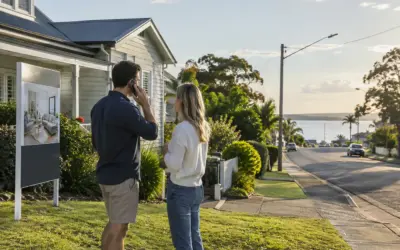
A couple we spoke with recently had found the right place in Woy Woy. Three bedrooms, close to the station, a backyard for the dog. The agent’s price guide sat just under $800,000. Then a second buyer turned up, and the conversation moved past that number very quickly. What they hadn’t worked out was what a few extra thousand dollars on the price would do to their first home buyer stamp duty in NSW. For a first home buyer, that $800,000 line matters more than almost anything else in the budget.
This guide covers how first home buyer stamp duty works in NSW, what the thresholds actually are, and where we see Central Coast buyers get caught out. Rules change, so treat this as a plain English starting point and confirm your own situation with Revenue NSW or your conveyancer before you sign anything.
The short answer: under $800,000, most first home buyers pay no duty
Stamp duty (officially called transfer duty) is the tax the NSW Government charges when property changes hands. For most buyers it is one of the biggest costs after the deposit itself, and it has to be paid in cash. It can’t be rolled into the home loan.
First home buyers get relief through the First Home Buyers Assistance Scheme, run by Revenue NSW. According to Revenue NSW and the NSW Government, the scheme works on the value of the property:
- Homes valued up to $800,000: no transfer duty at all.
- Homes between $800,000 and $1,000,000: a concessional rate, meaning reduced duty on a sliding scale.
- Homes at $1,000,000 or more: full standard duty.
Vacant land has its own lower thresholds. Land up to $350,000 is exempt, land between $350,000 and $450,000 gets the concession, and above $450,000 the normal rates apply. That matters if you’re buying a block in one of the newer northern estates to build on.
The exemption applies to both new and existing homes. You don’t have to buy brand new to qualify, which surprises a lot of people who have the First Home Owner Grant rules in their head.
The concession band is where the money disappears
Here is the part that catches people. The concession between $800,000 and $1,000,000 is a sliding scale, not a cliff. That sounds gentle. In practice, every dollar you add to the price in that band adds duty on top, so you are paying more twice: once to the seller and again to Revenue NSW.
On the Central Coast, a lot of first home stock sits right around that $800,000 line. Think older brick homes in Umina Beach or Kanwal, townhouses near Erina, or a renovated cottage in Wyong. When a property is guided at $780,000 and the bidding climbs to $830,000, you aren’t just finding another $50,000. You are also finding the duty that now applies to the whole purchase.
So before you go to auction or put in a final offer, run the numbers at three prices: your target, your walk away figure and one step past it. The NSW Government’s Home Buyer Assistance Finder and Revenue NSW’s duty calculator will show you exactly what each one costs. We would rather you see that figure on a quiet weeknight than in the middle of a bidding war.
This is also why we treat the threshold as part of the negotiation. Where a seller has some flexibility, landing a deal at or under $800,000 rather than just over it can be worth far more to a first home buyer than the headline difference suggests. Our guide on putting in an offer on a NSW home covers how to frame that conversation with an agent.
One warning. Some buyers hear that splitting the price between the house and its furniture or chattels reduces duty. Revenue NSW looks closely at this, and anything that isn’t a genuine, fairly valued arrangement can lead to the duty being reassessed. Don’t build your budget around it.
Who actually qualifies
The scheme is aimed at genuine owner occupiers buying their first home. Based on the NSW Government’s published criteria, you need to meet all of these:
- You are at least 18 years old.
- At least one buyer is an Australian citizen or permanent resident.
- Neither you nor your spouse or partner has owned or co-owned residential property in Australia before.
- You move in within 12 months of buying and live there continuously for at least 12 months.
The ownership rule is broader than most people expect. It covers your partner too, even if they aren’t on the title for this purchase. If your partner owned a unit in Sydney years ago, check the rules before assuming you qualify.
The occupancy rule is the other trap. If your plans change and you rent the place out before you’ve lived there for 12 continuous months, the concession can be taken back and you may have to pay the duty after all. We see this come up with buyers relocating from Sydney who plan to rent the new place out for a while before they move. That approach generally doesn’t fit the scheme.
The $10,000 grant is a separate thing
The First Home Owner Grant often gets mixed up with the stamp duty exemption. They are two different programs with different rules.
The grant is a $10,000 payment for first home buyers purchasing or building a new home. According to the published criteria, the home must be valued up to $600,000, or up to $750,000 for a house and land package. An established home doesn’t qualify, no matter the price.
On the Central Coast, that means the grant mostly comes into play in the growth areas around Warnervale, Woongarrah, Hamlyn Terrace and Wadalba, where new builds and house and land packages are more common. If you’re buying an existing house in Gosford or The Entrance, plan on the stamp duty exemption and leave the grant out of your numbers.
Can you get both? If the property meets both sets of rules, yes. A new home under the grant cap will usually sit well under the $800,000 duty threshold as well. Just confirm each one separately, because the application paths differ.
How the exemption gets applied in practice
You don’t receive a cheque. The exemption is applied when your duty is assessed, which your conveyancer or solicitor arranges as part of the purchase. Your part is to tell them early that you are a first home buyer, and to answer the eligibility questions honestly.
A few things make this smoother:
- Mention your first home buyer status to your lender and conveyancer at pre-approval, not after exchange.
- Keep evidence that you moved in, such as updated licence details, bills and electoral enrolment.
- If buying with a partner, check their ownership history before you start making offers.
Settlement is where it all comes together. Our walk through of what happens on settlement day explains how the funds move on the day.
Stamp duty is only one line in the budget
Even with a full exemption, buying a first home isn’t free beyond the deposit. You still need to budget for conveyancing, a building and pest inspection, loan costs, and possibly lenders mortgage insurance if your deposit is under 20 percent. Then there’s moving, connections and the small repairs every new owner finds in the first month.
The exemption is a big help. It doesn’t replace a proper budget. The buyers we see do best know their full cash position before they inspect anything, so they can tell straight away whether a property guided near the threshold is realistic.
If you’d like someone in your corner for that, our first home buyer service on the Central Coast covers the search, the price negotiation and the run up to settlement. We work on a flat fee, so our interest is getting you the right home at the right price, not pushing the number higher.
Common questions about first home buyer stamp duty in NSW
What is the stamp duty exemption for first home buyers in NSW?
Under the First Home Buyers Assistance Scheme, eligible first home buyers pay no transfer duty on a new or existing home valued up to $800,000. Homes between $800,000 and $1,000,000 get a reduced, sliding scale rate. For vacant land the exemption applies up to $350,000, with a concession up to $450,000.
How much stamp duty would I pay on a $700,000 house in NSW?
If you are an eligible first home buyer and it is the home you will live in, you would pay no transfer duty, because $700,000 is under the $800,000 threshold. If you aren’t eligible, standard duty applies. Revenue NSW’s online calculator will give you the exact figure for your situation.
How do I avoid paying stamp duty in NSW?
The legitimate way is to qualify for the First Home Buyers Assistance Scheme and buy within its thresholds. Keeping the purchase price at or under $800,000 makes a large difference. Artificial arrangements, like inflating the value of chattels, can be reassessed by Revenue NSW, so get advice before trying anything creative.
How is buyer stamp duty calculated?
Duty is based on the dutiable value of the property, which is usually the purchase price or market value, whichever is higher. First home buyer concessions are then applied on top. The simplest approach is to use the Revenue NSW calculator or the NSW Government’s Home Buyer Assistance Finder with your expected price.
Can I get the First Home Owner Grant and the stamp duty exemption together?
Yes, if the property meets both sets of rules. The $10,000 grant only applies to new homes valued up to $600,000, or house and land packages up to $750,000, so it suits new builds rather than established homes. Check each program’s eligibility separately.
What happens if I rent the property out in the first year?
You need to move in within 12 months and live there for at least 12 continuous months. If you don’t, the concession can be withdrawn and you may need to pay the duty you were excused from. If your plans might change, talk to your conveyancer before you exchange.
Buying your first home on the Central Coast and want help keeping the price where your budget works? Have a look at how our buyers agent support for first home buyers works, then get in touch for a chat about what you’re looking for.